
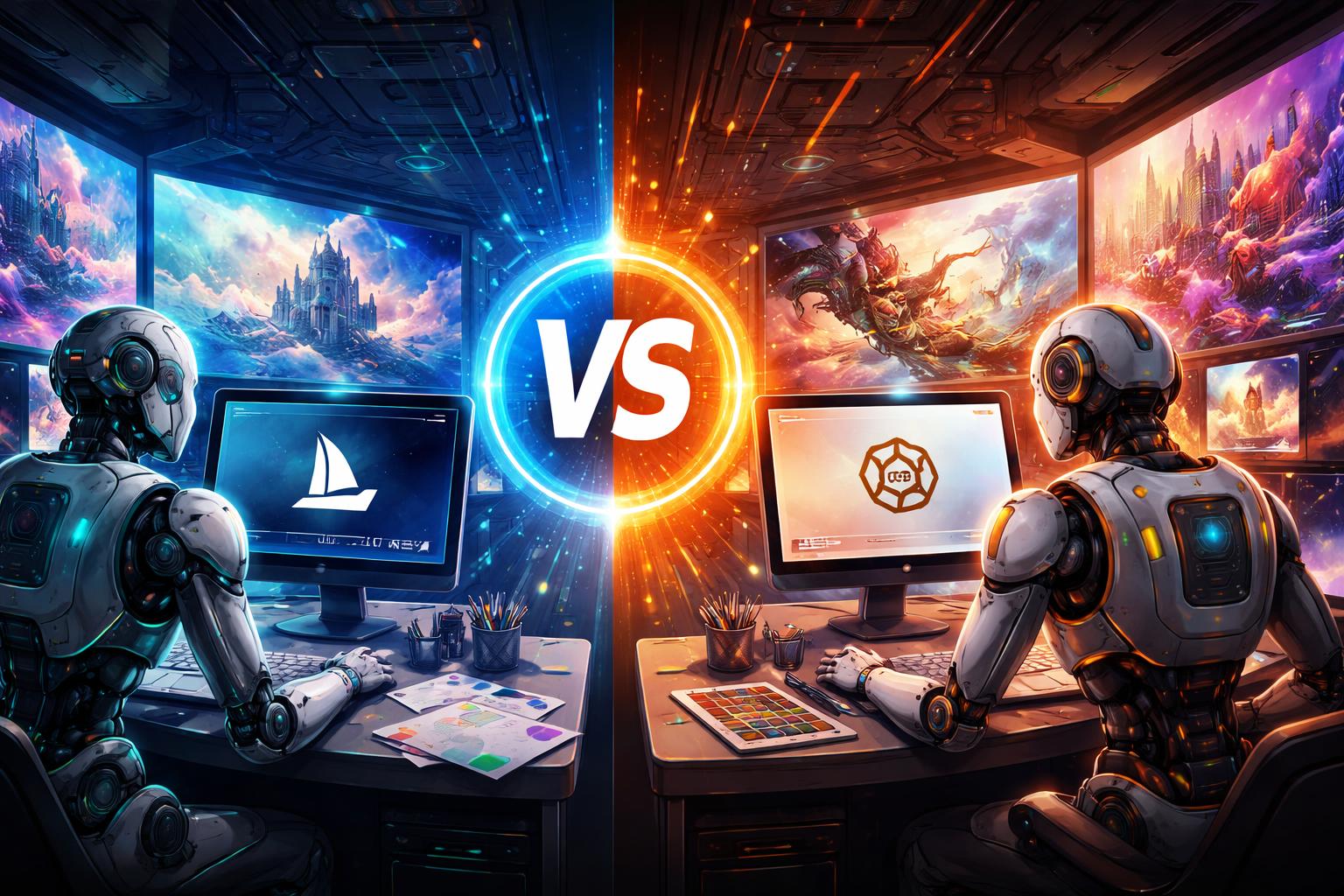
Midjourney vs. DALL-E 3: Best AI for Commercial Art
Choosing the best AI image generator for commercial art largely depends on your specific project needs and desired aesthetic. For generating highly artistic, aesthetically pleasing, and stylistically consistent imagery that often requires less precise textual adherence but a strong visual impact, Midjourney often takes the lead. However, for projects demanding exceptional prompt accuracy, the ability to render legible text within images, and seamless integration into conversational AI workflows, DALL-E 3, especially when accessed through platforms like ChatGPT or Microsoft Copilot, proves to be the superior choice.
The rise of artificial intelligence in content creation has revolutionized how businesses approach commercial art. From marketing campaigns and product mockups to concept art and social media visuals, AI image generators offer unprecedented speed and creative possibilities. Midjourney and DALL-E 3 stand out as two of the most powerful and popular tools in this domain, each with unique strengths that cater to different commercial demands.
Understanding AI Image Generation for Business
AI image generation tools leverage complex algorithms and vast datasets to transform textual descriptions (prompts) into visual artworks. For commercial purposes, these tools are invaluable for several reasons:
- Speed and Efficiency: Generate multiple visual concepts in minutes, dramatically cutting down design time.
- Cost-Effectiveness: Reduce reliance on stock photography or traditional design processes for initial concepts.
- Creative Exploration: Experiment with diverse styles, themes, and compositions without limitations.
- Personalization: Create highly specific and unique visuals tailored to a brand’s exact requirements.
While both Midjourney and DALL-E 3 achieve these benefits, their underlying architectures and design philosophies lead to distinct outputs and user experiences.
Midjourney: The Artistic Visionary
Midjourney has quickly gained a reputation for its ability to produce stunning, high-quality, and often breathtaking artistic imagery. It excels in creating visuals with a distinct aesthetic appeal, often leaning towards cinematic, painterly, or illustrative styles. Users frequently describe Midjourney’s output as having an inherent “artistic flair” or a “magical touch.”
The Aesthetic Edge
Midjourney’s strengths lie in its sophisticated understanding of composition, lighting, and mood. It’s particularly adept at:
- High Aesthetic Quality: Images often have a polished, professional, and visually engaging look directly out of the generator.
- Artistic Interpretation: It excels at interpreting abstract or evocative prompts into visually rich scenes, making it ideal for conceptual art or mood boards.
- Stylistic Cohesion: When guided with specific stylistic keywords, Midjourney can maintain a consistent visual theme across multiple generations, which is crucial for branding.
- Complex Scene Generation: It handles intricate details, textures, and lighting effects exceptionally well, resulting in photorealistic or fantastical landscapes, characters, and objects.
Ideal Use Cases for Midjourney in Commercial Art
For businesses, Midjourney is an invaluable asset for:
- Brand Identity and Marketing Campaigns: Creating striking hero images, abstract visuals for brand storytelling, or unique graphics for advertising that capture attention.
- Concept Art and Visual Development: Generating ideas for game design, film production, product packaging concepts, or interior design mockups.
- Editorial Illustrations: Producing unique artwork for articles, blog posts, or digital publications that require a distinct artistic touch.
- Social Media Content: Crafting eye-catching, shareable visuals that stand out in crowded feeds, especially for brands with a strong visual identity.
- Fashion and Lifestyle Photography Concepts: Designing elaborate scenes, outfits, and settings for photoshoots before they happen.
DALL-E 3: Precision and Practicality
DALL-E 3, developed by OpenAI, marks a significant leap in AI image generation, particularly in its ability to understand and execute complex prompts with remarkable accuracy. Its integration with conversational AI tools like ChatGPT makes it incredibly user-friendly and powerful for commercial applications that demand precision and control.
Controlling Creativity with Prompts
DALL-E 3’s standout features revolve around its intelligent prompt interpretation and practical applications:
- Superior Prompt Adherence: It excels at understanding detailed and lengthy prompts, generating images that closely match the user’s description, including complex scene arrangements and specific object placements.
- Legible Text Generation: This is a powerful tool for commercial art. DALL-E 3 can reliably generate accurate and readable text within images, making it perfect for advertisements, product labels, or social media graphics that require specific messaging.
- Seamless Integration: Through platforms like ChatGPT, users can have a conversational experience, refining prompts iteratively and easily generating variations, making the design process intuitive and efficient.
- Versatile Styles: While it may not always have the inherent “artistic flair” of Midjourney, DALL-E 3 is highly versatile in mimicking various art styles, from photorealistic to cartoonish, based on the prompt’s instructions.
- Safety and Content Moderation: Being integrated into OpenAI’s ecosystem, DALL-E 3 often comes with robust content moderation policies, ensuring generated images are suitable for commercial use and avoid sensitive or harmful content.
Ideal Use Cases for DALL-E 3 in Commercial Art
For businesses prioritizing precision and integrated text, DALL-E 3 offers substantial advantages:
- Advertising and Marketing with Text: Creating banner ads, social media posts, or print materials that require specific slogans, product names, or calls to action within the image itself.
- Product Mockups and Packaging Design: Generating visuals of products with custom branding, logos, and detailed text on packaging.
- Website Graphics and UI Elements: Designing specific icons, banners, or background images that align perfectly with a website’s theme and functional requirements.
- Presentation Visuals: Crafting custom illustrations or infographics for business presentations that convey precise information.
- Educational Content: Developing visuals for e-learning modules, textbooks, or instructional materials where clarity and accurate representation are paramount.
Head-to-Head: Midjourney vs. DALL-E 3 for Commercial Art
To help you decide, here’s a direct comparison of their key attributes relevant to commercial art:
| Feature | Midjourney | DALL-E 3 (via ChatGPT/Copilot) |
|---|---|---|
| Artistic Style & Aesthetic | Highly aesthetic, often cinematic, painterly, or illustrative; distinct visual signature; excels at mood and atmosphere. | Versatile, aims for photorealism or specific styles based on detailed prompts; less inherent “style” but highly adaptable. |
| Prompt Interpretation | Good at interpreting artistic concepts; sometimes requires more iterative prompting to achieve desired realism or specific details. | Exceptional at understanding complex, lengthy, and nuanced prompts, leading to highly accurate and predictable results. |
| Text Generation within Images | Generally struggles with legible and accurate text generation; often renders gibberish or distorted words. | Excellent at generating accurate, legible, and stylistically appropriate text directly within the image. |
| Ease of Use & Workflow | Primarily accessed via Discord bot; can be steep learning curve for advanced features; good for community interaction. | Seamlessly integrated into conversational platforms like ChatGPT, offering an intuitive, iterative, and conversational prompting experience. |
| Control & Precision | More focused on artistic interpretation; can be harder to achieve pixel-perfect control over specific elements or compositions. | Offers superior control over scene composition, object placement, and adherence to specific details mentioned in the prompt. |
| Ideal Commercial Use Cases | Branding aesthetics, concept art, editorial illustrations, evocative marketing visuals, creative storytelling. | Advertising with text, product mockups, precise social media graphics, UI elements, data visualization, educational content. |
Workflow Integration and Accessibility
The operational flow for each tool also influences its suitability for different business environments.
Midjourney’s Discord-Centric Experience
Midjourney primarily operates within Discord, a chat application. Users interact with the AI bot by typing commands into designated channels. While this offers a vibrant community aspect and opportunities to learn from others, it can be a barrier for those unfamiliar with Discord or who prefer a more traditional UI. The iterative process often involves generating multiple variations (`U` for upscale, `V` for variation) and refining prompts through repeated attempts.
DALL-E 3’s Conversational Interface
DALL-E 3’s primary access point for many commercial users is through ChatGPT Plus or Microsoft Copilot Pro. This conversational interface is highly intuitive. You can simply describe what you want, and if the initial output isn’t perfect, you can chat with the AI to refine it, ask for specific changes, or generate entirely new concepts based on previous discussions. This natural language interaction streamlines the creative process, especially for those who prefer describing their vision rather than mastering specific AI commands.
Real-World Commercial Applications
Let’s explore deeper into how these tools can be applied across different business sectors.
Branding and Marketing
- Midjourney: Imagine a luxury brand needing to convey elegance and sophistication. Midjourney can generate high-concept visual metaphors, abstract art for mood boards, or cinematic imagery for premium ad campaigns. Its ability to create distinct artistic styles helps establish a unique brand aesthetic.
- DALL-E 3: For a tech startup launching a new app, DALL-E 3 can quickly create social media graphics with the app’s name clearly rendered, banner ads showcasing specific features with explanatory text, or product mockups with the company logo and tagline precisely placed.
Product Development and Design
- Midjourney: A fashion designer can use Midjourney to visualize innovative garment styles, fabric textures, or entire runway show concepts, drawing inspiration from abstract prompts about “future trends” or “ethereal fabrics.”
- DALL-E 3: An e-commerce business needs to showcase a new line of customizable mugs. DALL-E 3 can generate images of the mugs with various designs, custom text, and even realistic mockups of different people holding them, all from a precise description.
Content Creation and Social Media
- Midjourney: A lifestyle blog might use Midjourney to generate evocative hero images for articles about travel destinations or wellness, focusing on aesthetic appeal and emotional resonance.
- DALL-E 3: A news outlet requires an image to accompany an article about local events, needing a specific date and event name displayed prominently. DALL-E 3 can produce a custom graphic with the correct, legible text, ensuring accuracy and immediate understanding.
Choosing the Right AI for Your Business Needs
The “best” AI is truly the one that aligns most closely with your project goals, internal workflows, and desired output quality.
- Opt for Midjourney if: Your primary goal is to generate highly artistic, visually stunning, and unique imagery where aesthetic impact outweighs pixel-perfect precision or legible text. You’re comfortable with a Discord-based workflow and enjoy iterating through visually diverse options.
- Opt for DALL-E 3 if: Your projects require extreme prompt accuracy, the ability to integrate legible text directly into images, or a highly conversational and iterative design process. You prioritize control over specific elements and a streamlined workflow within a chat interface.
Many businesses find value in utilizing both tools for different stages of their creative process. Midjourney might be used for initial conceptualization and mood boarding, while DALL-E 3 could then be employed for refining specific elements, adding textual details, or generating final assets that require precise execution.
The Evolving Landscape of AI Art for Business
The field of AI image generation is rapidly evolving. Both Midjourney and DALL-E 3 are continuously updated with new features, improved models, and expanded capabilities. As these tools become more sophisticated, they will increasingly integrate with other design software, offer more granular control, and potentially merge their unique strengths. The future will likely see even more versatile AI assistants capable of handling a broader spectrum of commercial art demands, pushing the boundaries of creativity and efficiency for businesses worldwide.
Frequently Asked Questions (FAQ)
Q1: Can AI-generated art be copyrighted for commercial use?
The copyright status of AI-generated art is a complex and evolving legal area. In many jurisdictions, human authorship is a prerequisite for copyright protection. This means that while you can typically use AI-generated art for commercial purposes, securing exclusive copyright ownership might be challenging without significant human intervention and creative input. Always consult with a legal professional regarding specific copyright concerns.
Q2: How do I ensure brand consistency when using AI tools for commercial art?
Ensuring brand consistency requires careful prompt engineering. With Midjourney, focus on incorporating brand-specific styles, color palettes, and thematic keywords into your prompts. With DALL-E 3, leverage its prompt accuracy to specify exact brand elements, logos, and color codes (if possible) in your descriptions. Both tools benefit from providing example images or detailed style guides in your prompts to maintain a cohesive brand look.
Q3: Are there ethical considerations when using AI for commercial art?
Yes, several ethical considerations exist. These include acknowledging the original artists whose works may have been used in the AI’s training data, avoiding the generation of harmful or stereotypical content, and transparency with your audience about the use of AI. It’s crucial to use these tools responsibly and consider their broader societal impact.
Q4: Can these AI tools replace human graphic designers?
No, AI tools like Midjourney and DALL-E 3 are powerful assistants, not replacements for human graphic designers. They excel at generating concepts, iterating quickly, and executing specific visual ideas. However, human designers bring critical thinking, strategic understanding, emotional intelligence, and nuanced creative direction that AI cannot replicate. The best approach is often a collaboration, where designers leverage AI to enhance their productivity and creative output.
Q5: What are the limitations of AI for complex commercial projects?
While powerful, AI tools still have limitations. They can struggle with perfect anatomical accuracy, understanding very subtle emotional nuances, or reliably rendering complex, multi-object scenes with absolute spatial precision every time. For highly intricate, sensitive, or truly bespoke projects requiring deep contextual understanding and specific brand storytelling, human oversight and intervention remain essential.
Ultimately, the choice between Midjourney and DALL-E 3 for commercial art isn’t about one being definitively “better,” but rather which tool is better suited for your specific task. Midjourney offers unparalleled artistic flair and evocative visuals, ideal for conceptual work and striking aesthetics. DALL-E 3, with its precise prompt adherence and game-changing text generation capabilities, is a powerhouse for practical, text-inclusive commercial designs. By understanding their distinct strengths, businesses can strategically leverage both to elevate their commercial art and streamline their creative workflows, pushing the boundaries of what’s possible in the digital age.